Hello! Here we are, half-way through spring, with one month away until summer. It's the perfect time to start bringing out your white clothing. Not saying there are rules when wearing white, as gone are the days when people put their whites away after Labour Day. Now you can wear white all year long!
But do you know what hue of white is best for you?
There are many shades and hues of white. It really makes a big difference, for example when choosing your wedding dress, to know your colour palette season. It could make or break your photos and with the dress being fairly central to the look of the day, getting your colours done by a professional image consultant will lead to identifying your season and undertones which could then lead you to your event colour theme for venue, flowers, and such. It's helpful too even if you just want to know the right colours work, socializing, or even choosing your next kitchen wall colour.
Feel free to reach out and book your colour analysis today; I would love to work with you.
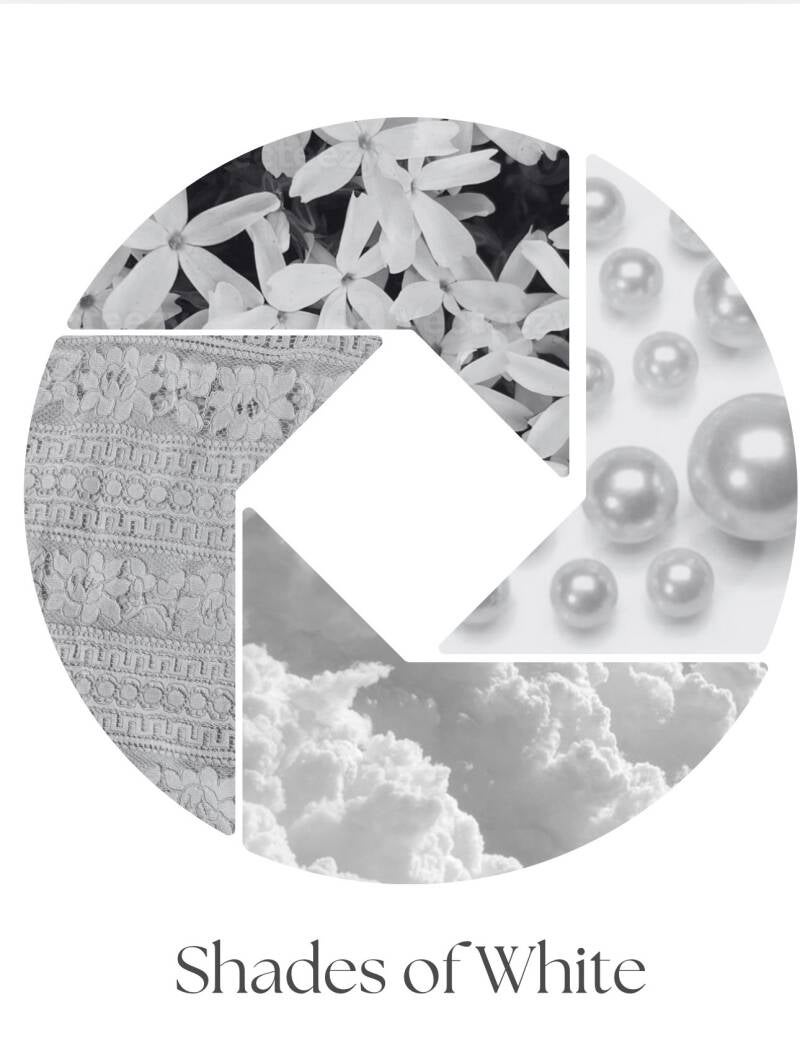
So let's get into it and explore this month's colour: WHITE.
White isn’t a single colour. It’s a family of pigments, dyes, minerals, and cultural meanings. Different shades of white have symbolized a range of things from danger to peace to surrender, and can express status and represent technology.
White in Art Movements
Minimalism
Artists like Kazimir Malevich explored white as abstraction and infinity, especially in works such as White on White (1918).
Modern architecture
Architects like Le Corbusier used white surfaces to express purity, geometry, and modernity.
Contemporary design
Today, warm whites dominate interiors because pure bright whites can feel clinical under LED lighting.
Scientific Perspective
White light contains the full visible spectrum. In pigments, white usually comes from materials scattering nearly all wavelengths of visible light rather than absorbing them.
The perception of white also changes based on:
- surrounding colours
- colour temperature of lighting
- texture and gloss
- human visual adaptation
That’s why the same paint can appear blue-white in daylight and cream-coloured at night.
White Historically
- marble in classical antiquity sculpture
- white porcelain from China
- rare natural white minerals and stones
- white linen in ancient Egypt
- white uniforms in naval and tropical military traditions
- white modernist buildings in the Mediterranean
- white pigments in art conservation
- white in fashion
- how white is used by different cultures in symbolism
Psychology of White
White rarely feels neutral emotionally; tiny shifts in undertone change perception dramatically.
Cool whites
Blue-leaning whites suggest:
- precision
- sterility
- technology
- winter
- distance
Hospitals and modern tech brands often use cool whites because they communicate efficiency and cleanliness.
Warm whites
Cream, ivory, and linen whites feel:
- intimate
- nostalgic
- handmade
- calming
These shades became especially popular in postmodern and Scandinavian-inspired interiors.
Off-whites and aging
Historically, perfectly bright white was difficult to maintain. Slight yellowing or grey tones often implied age, authenticity, historical continuity, and natural materials. That’s partly why antique paper, aged marble, and old textiles feel emotionally rich.
White in Fashion
Ancient world
In ancient Rome, white togas symbolized citizenship and status. Candidates for office wore specially whitened garments, giving rise to the word “candidate” from candidus (meaning bright white).
Religious symbolism
Many traditions use white garments for spiritual transformation:
- baptismal robes in Christianity
- white pilgrimage clothing in Islam
- white mourning garments in East Asia
Industrial Revolution
The ability to bleach textiles at scale transformed white into a symbol of hygiene and wealth during this time period. Before modern laundering, keeping clothing white was expensive and labour-intensive.
Modern fashion
Designers like Coco Chanel and Calvin Klein used white minimalism to signal modern sophistication.
The white T-shirt evolved from undergarment to cultural icon through James Dean and Marlon Brando.
Rare and Famous White Materials
Carrara marble
Carrara marble became legendary through Renaissance sculpture. Michelangelo chose specific marble blocks personally for works like David. The stone’s faint grey veining creates depth within apparent whiteness.
Porcelain
Chinese white porcelain from the Ming era became one of the world’s most desired luxury goods. European courts spent centuries trying to replicate its luminous white glaze.
White gold
Not naturally white, but alloyed from yellow gold with metals such as palladium or nickel, white gold is associated with modern luxury became especially popular in the 20th century
Famous Artistic Explorations of White
Whistler's Mother (James McNeill Whistler, 1871) - Uses restrained whites and greys to create emotional quietness.
White on White (Kazimir Malevich, 1918) - A near-monochrome exploration of spirituality and abstraction.
The White Album (The Beatles, 1968) - The blank white cover became a statement against excess visual branding.
White in Architecture
Mediterranean white cities
Places like Santorini, Greece became iconic for whitewashed buildings. The white lime coating reflects heat, reduces bacteria, and brightens narrow streets.
Modernism
White architecture often changes dramatically across the day as shadows shift. Architects including Richard Meier used brilliant white surfaces to emphasize geometry and light.
Why We are Fascinated by White
White sits at a strange boundary:
- it can represent fullness (all light)
- or emptiness (blankness)
- purity or death
- luxury or simplicity
- silence or transcendence
Scientifically
Pure white light is essentially the combination of all visible wavelengths. In colour systems, white variations come from tiny additions of yellow, blue, grey, pink, green, and beige. These create distinct whites like ivory, cream, pearl, snow, alabaster, and eggshell.
Digitally
Computers can theoretically display millions of near-white colours. For example, in the additive colour model RGB (Red, Green, Blue) pure white is coded as (255,255,255). Any value variation from that becomes an off-white. Since RGB allows over 16 million colours, there are hundreds of thousands of distinguishable near-whites.
In Paint and Design
Paint companies often catalogue 50–300 named whites each. Brands like Benjamin Moore or Sherwin-Williams maintain extensive white collections because lighting changes perception dramatically.
Interior designers commonly classify whites into warm, cool, neutral, soft, and bright.
Names for White
Across art, textiles, architecture, and decoration, cultures have created hundreds upon hundreds of names for white tones, including ivory, chalk, bone, pearl, frost, cotton, and even toasted marshmallow!
Human Perception Limit
The human eye can distinguish hundreds of white variations under ideal lighting but context changes perception enormously. A white wall beside blue appears warmer. The same wall beside yellow appears cooler.
Artistic Perspective
Artists historically treated white as many different pigments rather than one colour:
- lead white
- zinc white
- titanium white
- chalk white
- lime white
Each reflected light differently and produced different emotional effects in paintings.
So how many hues of whites are there? Well, it honestly depends on what your project might be, be it a wardrobe, interior design, or advertisement.
Thank you for visiting my blog this week. Stay tuned over the next few weeks as I will be chatting about the different colours of each of the seasons that could be your palette.
~ Laura ~